
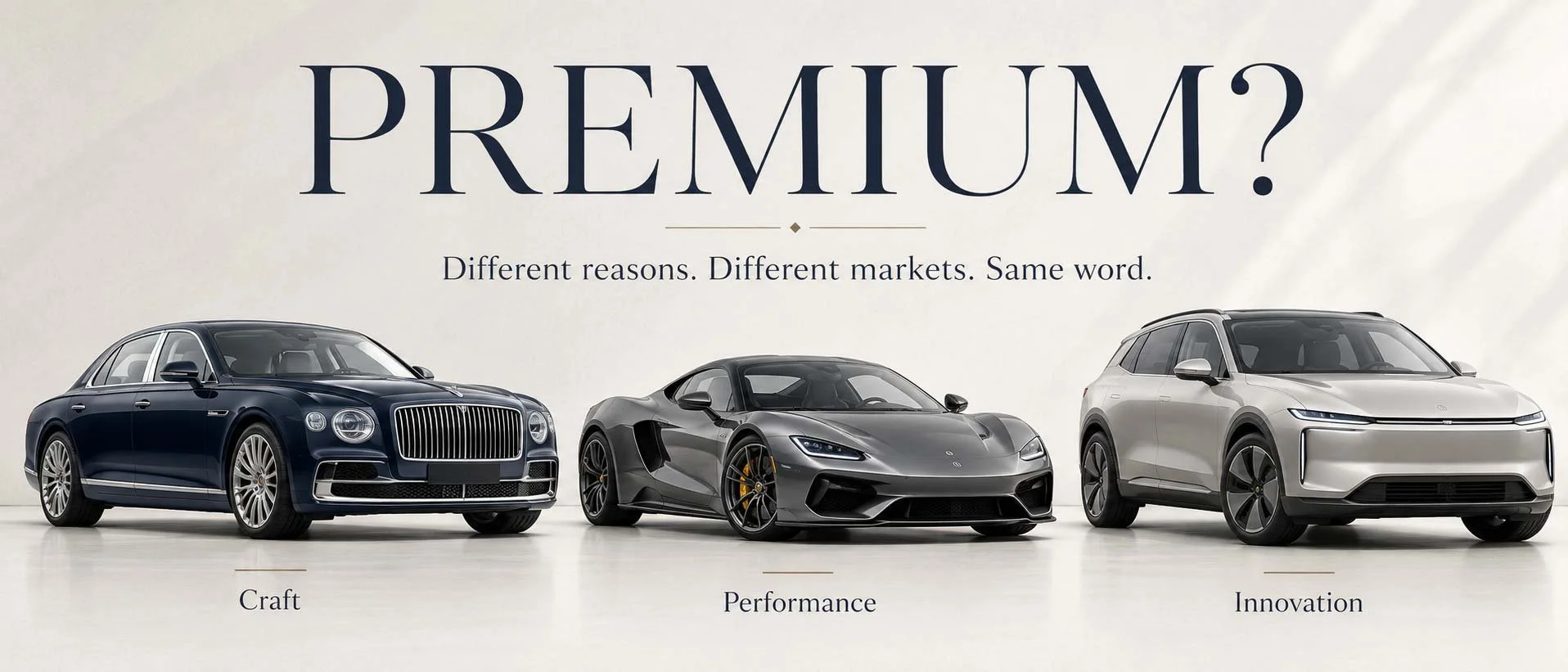
In short: premium isn't a fixed standard, it's a comparison against whatever someone is starting from. That's why the word alone tells a packaging supplier almost nothing useful, and why getting it right depends on working out what someone is actually comparing it to, not just hearing the word and guessing.
I don't think there's a single day that goes by without someone telling us they want premium packaging. Ask around the industry and I'd guess most of us would say the same thing. It's become the default word, the one everyone reaches for, whatever they're actually asking for underneath it.
Here's the trouble with it. Premium is a relative word, not a fixed one. It's like asking for a premium car. To someone driving a ten-year-old Fiesta, a top-spec new Mondeo might feel premium. To someone who drives a Porsche, it probably doesn't. To someone used to a Bentley, even the Porsche might not. Without knowing the budget and the expectation behind it, "premium" tells you almost nothing.
So why does almost everyone use the word anyway?
You'd think, given how little the word actually pins down, that people would reach for something more specific. They don't.
The vast majority of enquiries that land with us mention premium or an upgrade in some form. It's not the exception, it's close to a given, which is a strange thing to notice once you accept the word barely means anything fixed. If it doesn't pin anything down, why has it become the word almost everyone uses?
I think it comes down to ecommerce, and how much more the unboxing moment has come to matter. When a package lands on someone's doorstep and they open it up, there's a feeling brands are chasing now that didn't matter nearly as much when everything was bought off a shelf, the feeling of "I love this brand, I love what they've tried to do here." That feeling is entirely relative to what the person expected walking in. Everyone's chasing it, because nobody's expecting the same thing when they say it.
Retail and ecommerce are not the same job
It's worth being honest about something here, because the two get talked about as if they're the same problem wearing different clothes. They're not.
Retail packaging is doing something close to advertising, compressed into a split second. Walk into a supermarket and the competition on that shelf is enormous. You've got a blink of an eye to be read, understood and chosen over everything sat next to you, and a lot of research goes into making that split second work. If the packaging looks too expensive for the market it's in, it misses the mark. If it looks too cheap, it misses the mark just as badly. Either way, you don't get picked up.
Ecommerce doesn't work like that at all, because the decision's already been made by the time the box arrives, for reasons that might have nothing to do with the packaging: the price, a recommendation from a friend, whatever it was. The job of the packaging at that point isn't to win that sale, it's to influence what happens afterwards. If the box is a let down, that customer isn't likely to talk about the brand, and they might not buy again. If it's better than they expected, they'll tell other people, they'll remember it, and they're more likely to come back. It's a genuinely different psychology, not the same skill applied twice.
A good example of this is a brief we had where the client's own starting point was a plain shipping box with a printed label stuck on the side. Against that baseline, moving to a proper printed box felt like a real, meaningful upgrade to them, and it was, even though it wasn't anywhere near what most people in the industry would call premium production. Both things were true at once, because their version of premium was simply a significant step up from where they were already starting. That's the whole problem with the word in one small example.
Premium isn't the same thing as expensive
This is probably where the word causes the most trouble. There's an assumption that making packaging more premium means adding more expensive things to it: thicker board, more foil, more lamination, magnets, foam, ribbons, more layers, more theatre. Sometimes those things are exactly right, and sometimes they're completely wrong, because expensive packaging and packaging that makes a product feel premium aren't necessarily the same thing. Trying too hard to make something look expensive can very easily make it worse.
Premium is really about perceived value. Does the person opening it feel that what they've received is better than they expected? Does it feel right for the product they've bought and the brand they've bought it from? A beautifully engineered piece of uncoated board with very little print might communicate far more value in the right market than a huge laminated box covered in gold foil, because more doesn't automatically mean better.
Premium still has to match the brand, not just look expensive
Here's where it gets more interesting, because exceeding expectations doesn't mean the same thing for every brand, even when they're both chasing that same feeling.
Think about an expensive watch versus a genuinely organic skincare brand. The watch is usually selling precision, heritage and technical craft, so a heavy fitment, thick lamination and gold foiling might reinforce exactly that story. The skincare brand is usually selling something very different, natural, honest and relatively unprocessed, and putting the same materials and finishes around it can start working against the very thing the brand is trying to say. Different markets, different ethos, and "premium" has to bend to fit both, not flatten them into the same finish.
We see this a lot with cosmetics and skincare brands specifically. A good number of them come to us asking for foam inserts, and I genuinely think foam is the enemy of that market, because so much of the positioning is built around being organic, natural or environmentally conscious, and foam can say the opposite of that the second someone opens the box. When I raise it, the response is usually an immediate "oh yeah, of course." They know their own market better than we do, in theory. It's surprising how often it works the other way round in practice, and someone outside the brand has to be the one to notice the mismatch.
There's a wider point in there too. Premium doesn't necessarily mean more packaging. For some audiences, excessive packaging now communicates waste rather than luxury, and a smaller, precisely engineered pack using good materials and very little unnecessary decoration can feel considerably more sophisticated than something three times the size full of layers that don't need to be there. Restraint can be premium too.
Premium is also relative to the customer
There's another comparison going on that often gets missed. It doesn't really matter whether the founder thinks the packaging looks premium, and it doesn't particularly matter whether the designer thinks it looks premium either. What matters is whether the customer does.
A packaging designer can admire the print. A manufacturer can admire how something has been constructed. The business owner can know exactly what it cost. The person opening it doesn't know any of that. They're simply deciding, consciously or otherwise, whether what they've received feels right for what they bought and what they paid. So premium isn't really about how expensive the packaging is, it's about how valuable it feels to the person opening it. Change the audience, and that answer can change completely.
Budget decides what premium can actually be
There's a version of this conversation that happens in a car showroom too, and it's worth borrowing because it makes the next bit obvious. Walk in and tell a dealer you want a premium car, and a good dealer won't just nod and start showing you things. They'll ask what you actually need it for and, just as importantly, what you've got to spend, because it's entirely possible you don't mean premium at all once those details come out, or that the premium car in your head isn't one your budget can reach. Packaging works exactly the same way. Saying you want premium packaging tells a supplier nothing useful until the budget's on the table too.
This shows up constantly with lower-value products sold in relatively small volumes. Picture something like a candle, sold for somewhere around twenty pounds, being sold on an ongoing basis rather than as a one-off launch. A magnetic rigid box at low quantities can easily cost more than the product itself does to make. That doesn't necessarily mean the packaging is wrong, it means the economics might be. Premium packaging still has to survive the business model, because packaging doesn't become commercially sensible just because it looks right, and this isn't just a small-business problem either. Bigger, more established brands get this wrong as well.
It's not just what you say, it's who you say it to
Even once someone's got all of this right, there's a piece that catches people out that has nothing to do with the brief itself.
The answer you get to "what does premium mean?" depends enormously on who you ask, because a lot of companies in this industry naturally see the problem through the part they're responsible for. A design agency might understand the brand brilliantly but have less visibility of what a particular structure or material will actually involve in production. A production-led supplier might know exactly how to manufacture something but never question whether it's actually the right thing for the customer or the brand. Neither is necessarily doing anything wrong, they're solving the part of the problem they're there to solve. The useful conversation happens when whoever you're working with understands the brand, the structure, the production and the commercial reality together, because all four affect the answer.
That's really the point underneath everything else in this post. What premium actually means is better than the customer expected, appropriate for the brand they're buying from, and achievable within the economics of the product. Change the customer, the brand, the budget or the starting point, and the answer changes with it.
That's why "we want premium packaging" isn't a brief. It's an opening line, and the conversation is where the real one gets written. If you want to see what an actual brief looks like, we've covered that here, and if an AI tool had a hand in yours, it's worth reading why that often causes its own problems too.
